Online Image Abuse Against Women: A Growing Digital Threat
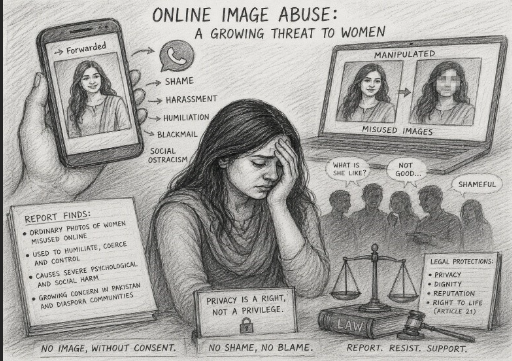
A recent report titled “Explicit Harms of Non-Explicit Images” highlights a disturbing form of online abuse where ordinary photographs of women are misused, manipulated, or circulated without consent to shame, harass, blackmail, or socially isolate them. The report emphasizes that even fully clothed photographs can cause severe harm in conservative social settings when they are intentionally shared to damage a woman’s reputation.
The article recounts the experience of a university lecturer whose estranged husband allegedly shared her private photographs through WhatsApp and manipulated some images to create false impressions about her personal life. As a result, she reportedly faced social ostracism from family members and colleagues. The report also notes that image-based abuse is no longer limited to explicit content, deepfakes, or revenge pornography; ordinary photographs, edited images, and personal pictures are increasingly being weaponized against women. The study found that such abuse is frequently used for humiliation, coercion, and social control.
Legal significance
The issue highlighted in this report reflects the growing challenge of image-based online abuse and cyber harassment, which has emerged as a serious threat to the privacy, dignity, reputation, and personal security of individuals, particularly women. The misuse of photographs through unauthorized sharing, manipulation, morphing, or circulation on digital platforms demonstrates how technological tools can be exploited to cause psychological distress, social stigma, reputational harm, and emotional trauma. Such conduct raises important concerns regarding the protection of personal data, digital privacy, and the responsible use of social media and communication platforms.
Action to be Taken
A victim should immediately preserve all available evidence, including screenshots, URLs, chat records, emails, social media posts, and details of the persons involved. The victim should avoid deleting messages and should maintain copies of the original content as digital evidence. Complaints can be filed before the nearest police station, the Cyber Crime Police Station, or through the Government of India’s cybercrime reporting portal. If the content is hosted on a social media platform, the victim should simultaneously use the platform’s reporting and takedown mechanisms and request urgent removal of the material.
Where the abuse involves morphing, impersonation, blackmail, threats, deepfakes, circulation of private photographs, or publication of intimate content, the victim should specifically request registration of appropriate offences under the BNS and Information Technology Act. If there is an imminent threat to safety or continued harassment, the victim may also seek protection orders and approach the court for directions to remove the offending content. Early reporting is crucial because digital evidence can be altered or deleted, and prompt intervention increases the likelihood of identifying the perpetrator and preventing further dissemination of the material.
📰 Source: Manorama Online (English)
Other Updates
Man Arrested for Allegedly Sexually Assaulting a Minor Girl on a Train
Ernakulam:Railway police arrested a man identified as Illiyas V. M. in connection with the alleged sexual assault of a minor…
Read More →Two Men Arrested in Case Involving Sexual Abuse of a Minor at a Kovalam Spa
Thiruvananthapuram:Police arrested two men in connection with the alleged sexual abuse of a minor at a spa in Kovalam. The…
Read More →Man Sentenced to 13 Years in Prison in POCSO Case
Thiruvananthapuram:A special POCSO court in Kattakkada sentenced a 27-year-old man to 13 years of rigorous imprisonment for kidnapping and sexually…
Read More →